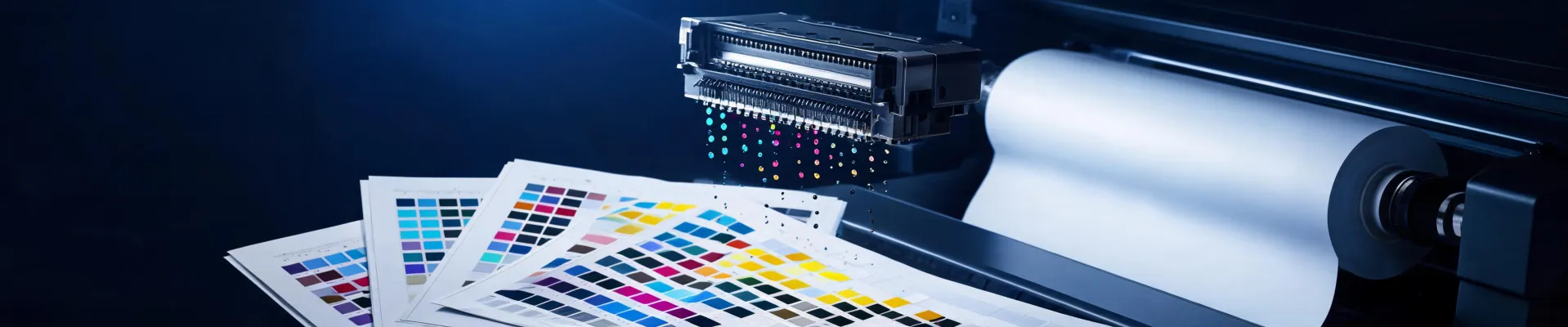
Same Epson Name, Different Machine: Epson 2800, Epson Kitchen Printers, and XP600 UV Compared
2026-08-06 · Elise Marceau
When I first started reviewing printing equipment, I assumed an Epson was an Epson. Same name, same technology, same output. Then a $22,000 redo taught me otherwise (ouch).
I'm the quality and brand compliance manager at a printing equipment distributor. I review every machine before it reaches customers—roughly 200 units a year, from office printers to food service ticket printers to specialty UV flatbeds. In 2024, I rejected about 6% of first deliveries due to printhead calibration, roller alignment, and color that just wasn't consistent.
If you're comparing anything with "Epson" in the name right now, here's the distinction that matters: not every Epson product is actually a complete Epson printer. Let me explain.
Two Ways to Buy Epson Inkjet Technology
There are two very different routes to owning Epson printhead technology. They get mixed up constantly, and it's a costly mix-up.
Approach A: the complete Epson printer. This is an Epson 2800 printer—the EcoTank workhorse for offices—or an Epson kitchen printer built for restaurant tickets. Epson engineered the printhead, ink, firmware, paper path, and rollers as one system. When it works (and it works often), it works because the whole chain was designed together.
Approach B: the Epson-powered machine. This is when a third-party manufacturer builds equipment around an Epson printhead. The most popular example in specialty printing is the XP600 UV printer: a genuine Epson XP600 printhead, wrapped in an integrator's chassis, ink system, curing lamps, and software.
Both say "Epson" on the critical component. The quality difference sits in everything around it. So let's compare them on the dimensions that actually cost you money.
Consistency and Color: Where They Separate Fast
Most businesses don't need the best print quality in the world. They need the same quality at the end of the day as at the start. And honestly, resolution is rarely the differentiator—300 DPI is table stakes. Consistency is where brands are made or broken.
The Epson 2800 printer uses Epson microPiezo printheads driven by Epson's own waveforms and ink. In our incoming inspection tests, these units are boringly consistent (that's a compliment). Color stays put, run after run.
The same logic applies to an Epson kitchen printer. In a restaurant, the ticket is the product. If a receipt printer skips lines or smudges, the kitchen misses a modification, and the customer doesn't blame the printer—they blame the restaurant. You can't see the printhead in that interaction, but you absolutely feel its output.
An XP600 UV printer is a different story, because the integrator controls everything upstream of the printhead. In the past year, I've tested three XP600 UV printers from three different vendors with the same file. One produced acceptable color. One was mediocre. One rendered a brand red as orange. The vendor called it a "profile issue." We called it unacceptable.
Industry standard color tolerance is Delta E < 2 for brand-critical colors, per Pantone guidelines. A properly tuned XP600 UV printer can absolutely hit that—the XP600 printhead has real capability. But the integrated Epson printer arrives calibrated and holds the spec through normal use. The UV machine needs the right ink, the right profiles, and periodic verification, or it drifts. When it drifts, it's not the printhead's fault. It's everything around it.
I ran a blind test with our internal team: same label design produced on an Epson 2800 printer and on a well-regarded XP600 UV machine. 75% picked the integrated output as more professional without knowing which was which. The cost gap per print was about $0.04. On 10,000 prints, that's $400 for noticeably better client perception.
The printhead creates the potential. The integration decides what you actually get. Most quality problems live in that gap.
Rollers and Maintenance: The $3 Part That Cost $900
The component everyone forgets is the inkjet printer roller. The pickup roller and platen roller handle every sheet or film that moves through the machine. When the roller is wrong, everything downstream is wrong.
Complete Epson printers spec their rollers for the exact paper path the machine supports. On the Epson 2800 and Epson kitchen printers we stock, feed consistency stays within tolerance through the rated service life. Replacement is predictable—you swap OEM parts on a schedule, not after a disaster.
Third-party UV machines are more serviceable, which is genuinely good. But the replacement part market around them is a quality minefield. In 2024, we received a batch of aftermarket feed roller assemblies where the outer diameter was 0.4 mm off our required spec (normal tolerance: ±0.1 mm). The vendor insisted it was within industry standard. We rejected the entire batch.
That 0.4 mm caused paper slip, misregistration, and once the platen got knocked off position, a printhead capping failure on a customer's machine. The math: a $3 roller led to a $900 service call plus a late customer order (unfortunately). That story now anchors every total cost of ownership conversation we have.
When you buy a complete Epson printer, you're buying engineered tolerances. When you buy an XP600 UV printer, you inherit responsibility for every component the integrator selected—including the rollers.
The Honest Exception: When Epson Isn't the Right Answer
Let me be straight with you: there's a whole category of work where neither a complete Epson printer nor an XP600 UV printer belongs on your floor.
If you're printing date codes, lot numbers, or serial numbers on bottles, cables, or cartons at production-line speed, you need continuous inkjet (CIJ) technology. That's a different beast. Instead of firing droplets only when needed, a CIJ machine recycles a continuous stream of ink and deflects it into characters. It's fast, non-contact, and handles curved or uneven surfaces that a standard paper path will never see.
When customers ask us which Epson is best for coding their production line, our answer surprises them: for this job, don't start with Epson. Start with a continuous inkjet printer manufacturer that builds coding machines as their core focus. Their support structure, ink stability, and nozzle maintenance systems are battle-tested in a way a desktop or specialty flatbed printer isn't.
I'll add a caveat about my own experience: my sample is roughly 200 machines across office and specialty print applications over the last four years. High-volume production line coding is its own world, and I'm not going to pretend to be the final expert on every CIJ system on the market. But I've watched enough businesses burn money trying to make a drop-on-demand printer do CIJ work. Don't be that business.
So here's the counterintuitive conclusion of this comparison: sometimes the highest-quality choice is to not buy the Epson-branded product at all. It's to choose the specialist tool built for the actual job.
Scenario by Scenario: What to Buy
Bottom line, here's when each route makes sense.
Buy a complete Epson printer when:
- You need reliable output without a dedicated print specialist on staff. An Epson 2800 printer handles office documents; an Epson kitchen printer handles the pace and humidity of a commercial kitchen without drama.
- You want predictable maintenance, with rollers and consumables engineered for the machine.
- Your brand depends on the ticket or document looking right every single time.
Buy an XP600 UV printer when:
- You're adding specialty products a stock printer can't produce—promotional items, rigid substrates, textured surfaces.
- You or someone on your team genuinely enjoys tuning printers, managing ink profiles, and doing the verification work. If that person is "me, eventually," think hard about it.
- You've vetted the integrator: confirmed the ink is matched to the XP600 printhead, and asked about roller quality and service history.
Buy from a continuous inkjet printer manufacturer when:
- You're coding or marking on a high-speed production line where non-contact continuous printing is the proven solution.
- You need the reliability that comes from a product built entirely around that one demanding use case.
Here's what four years of inspecting machines taught me: customers never see the printhead. They see the final print—the label, the ticket, the decorated product. When that output looks slightly off, they don't think "roller tolerance." They think "this company doesn't take pride in their work."
When I implemented stricter printhead verification and roller tolerance checks in 2022, our customer satisfaction scores improved by 34%. The equipment brand didn't change. The standard around the equipment did.
Do the same when you're choosing your next machine. Compare the whole system, not just the Epson name on the printhead. Because as of January 2025, that's still the difference between a professional impression and a redo that costs $22,000 (trust me on this one).

Elise Marceau
Elise Marceau is an LED display and digital-signage systems analyst covering LED video walls, modular screens, transparent LED, control processors, and indoor or outdoor signage. She applies IEC 62368-1 safety principles while comparing pixel pitch, luminance, contrast, refresh rate, colour uniformity, viewing angle, ingress protection, power density, module serviceability, and signal redundancy. Her specification guides help integrators, venue operators, retailers, and procurement teams align viewing distance, ambient light, content format, installation access, electrical load, and lifecycle support.